

`camtrapReport` is an open-source R package designed to make the analysis and reporting of wildlife camera-trap data more consistent, reproducible, and adaptable. It provides an automated workflow for processing data in the Camtrap DP format and generating two complementary outputs: a Data Status Check that assesses data quality and completeness, a ...
Last Update: 2026
Data reporting Data analysis Species populations Community composition Terrestrial Birds Mammals Reptiles Amphibians
Login to add the tool into your favorites.
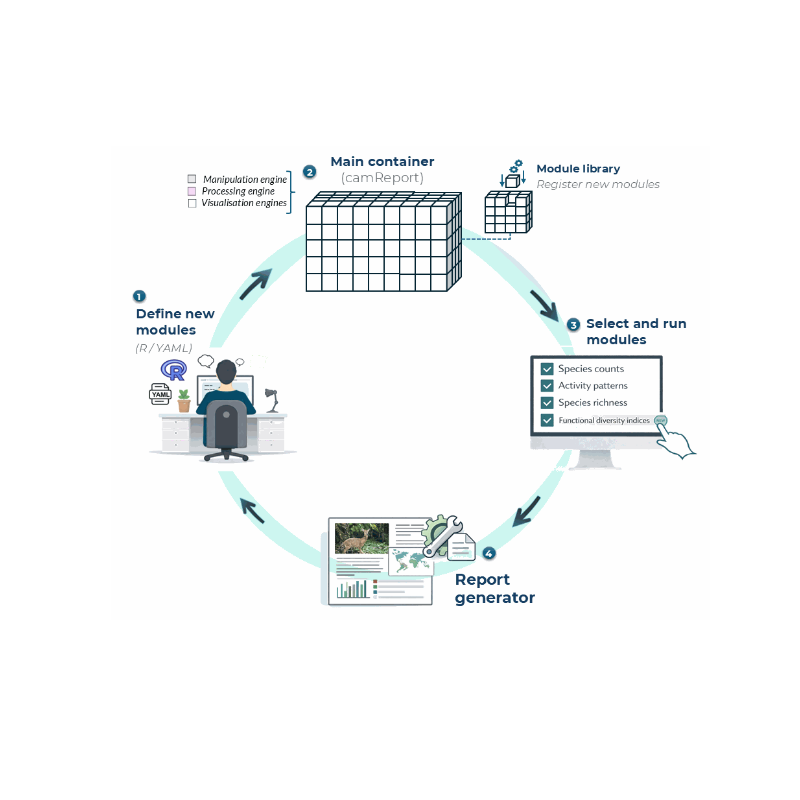
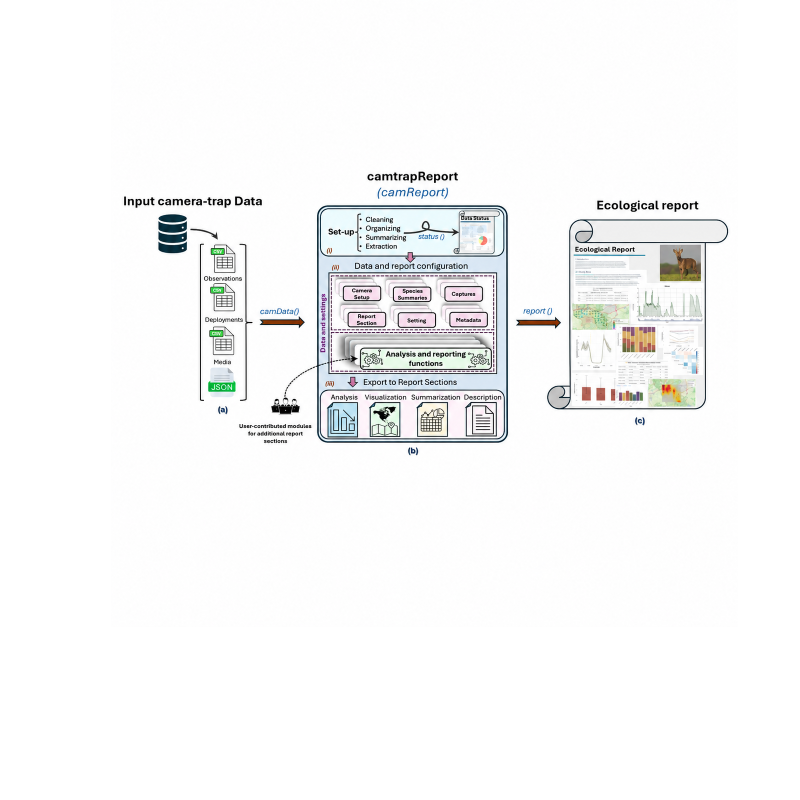
`camtrapReport` is an open-source R package designed to make the analysis and reporting of wildlife camera-trap data more consistent, reproducible, and adaptable. It provides an automated workflow for processing data in the Camtrap DP format and generating two complementary outputs: a Data Status Check that assesses data quality and completeness, and an Ecological Report that integrates ecological analyses, summaries, visualizations, maps, figures, and explanatory text. Although considerable progress has been made in standardizing camera-trap sampling protocols and data formats, differences in analytical methods, parameter settings, and processing rules can still produce different ecological estimates, potentially affecting biodiversity assessments and conservation decisions. To address this challenge, `camtrapReport` goes beyond automated reporting by supporting reusable analytical components and monitoring-specific analytical profiles. These profiles specify which methods are used, how they are configured, and how results are reported, helping monitoring programs maintain consistent and reproducible analytical procedures. Through its modular and extensible architecture, `camtrapReport` provides a foundation for shared analytical infrastructure across camera-trap monitoring networks. It supports the reuse and adaptation of analytical workflows across sites, researchers, and successive monitoring periods while accommodating different ecological objectives and monitoring protocols. The package can be used directly through R or an optional graphical interface.
Monitoring program(s) or initiative(s) using the tool:
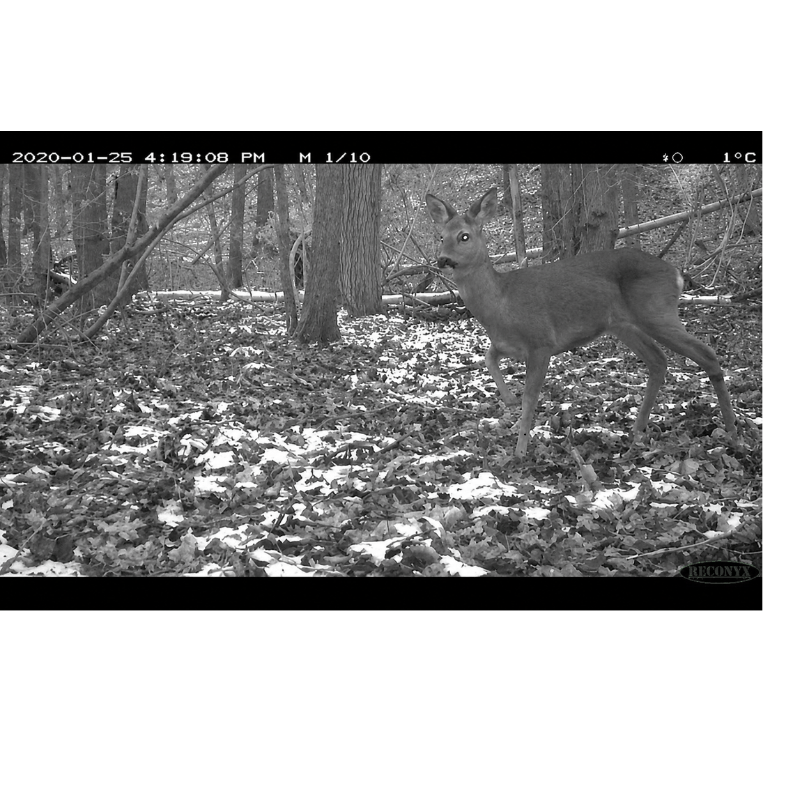
`camtrapReport` has been developed and tested using camera-trap datasets from monitoring sites across five continents, including publicly available datasets accessed through the Global Biodiversity Information Facility (GBIF). Extensive testing has also been conducted using data from the European Observatory of Wildlife (EOW), including repeated monitoring surveys. These applications have contributed to the development, testing, and refinement of the package.
| Contact person: | Elham Ebrahimi |
|---|---|
| Contact e-mail: | eebrahimi.bio@gmail.com |
| Contact Organization: | Wageningen University and Research |
| License: | MIT License (https://github.com/spatialecology/camtrapReport/blob/main/LICENSE.md) |
| Technical Status: | Finish and with constant technical support |
| Recommendation for its use: | `camtrapReport` is recommended for wildlife researchers, conservation practitioners, citizen scientists involved in camera-trap monitoring, and biodiversity monitoring programs. It is suitable for individual research projects, coordinated monitoring networks, and repeated surveys where consistent, reproducible analysis and reporting are needed. The package supports the complete workflow from data-quality assessment and preparation to ecological analysis, visualization, and automated report generation. It provides more than 30 analytical and reporting modules covering sampling effort, species occurrence and richness, capture rates and relative abundance, species co-occurrence, activity patterns, habitat associations, population density estimation, and spatial and temporal summaries. Users can generate Data Status Check and Ecological Reports in HTML or PDF format, with results presented through tables, figures, maps, and explanatory text. Reports can also be shared with monitoring partners and decision-makers without requiring public release of the underlying camera-trap records. The package's modular and extensible architecture allows users to select, reorder, remove, or modify report sections, customize analytical settings, explanatory text, visualizations, and underlying R code, and develop new analytical and reporting modules tailored to their research questions. It also supports monitoring-specific analytical profiles that define how methods are selected, configured, and reported. For example, an EOW-specific profile provides a predefined workflow based on the analytical requirements of the European Observatory of Wildlife, supporting consistent application of analytical procedures across sites and successive monitoring periods. Other profiles can be developed for different monitoring programs and projects. Input data should follow the Camtrap DP standard. The package can be used through R or an optional graphical interface, making it accessible to users with different levels of programming experience. The suitability and interpretation of ecological analyses depend on the sampling design, data quality, and assumptions of the selected methods. |
| URL(s): | https://spatialecology.github.io/camtrapReport/ |
Login to add a review for the tool camtrapReport
TOOLS YOU MAY ALSO LIKE


